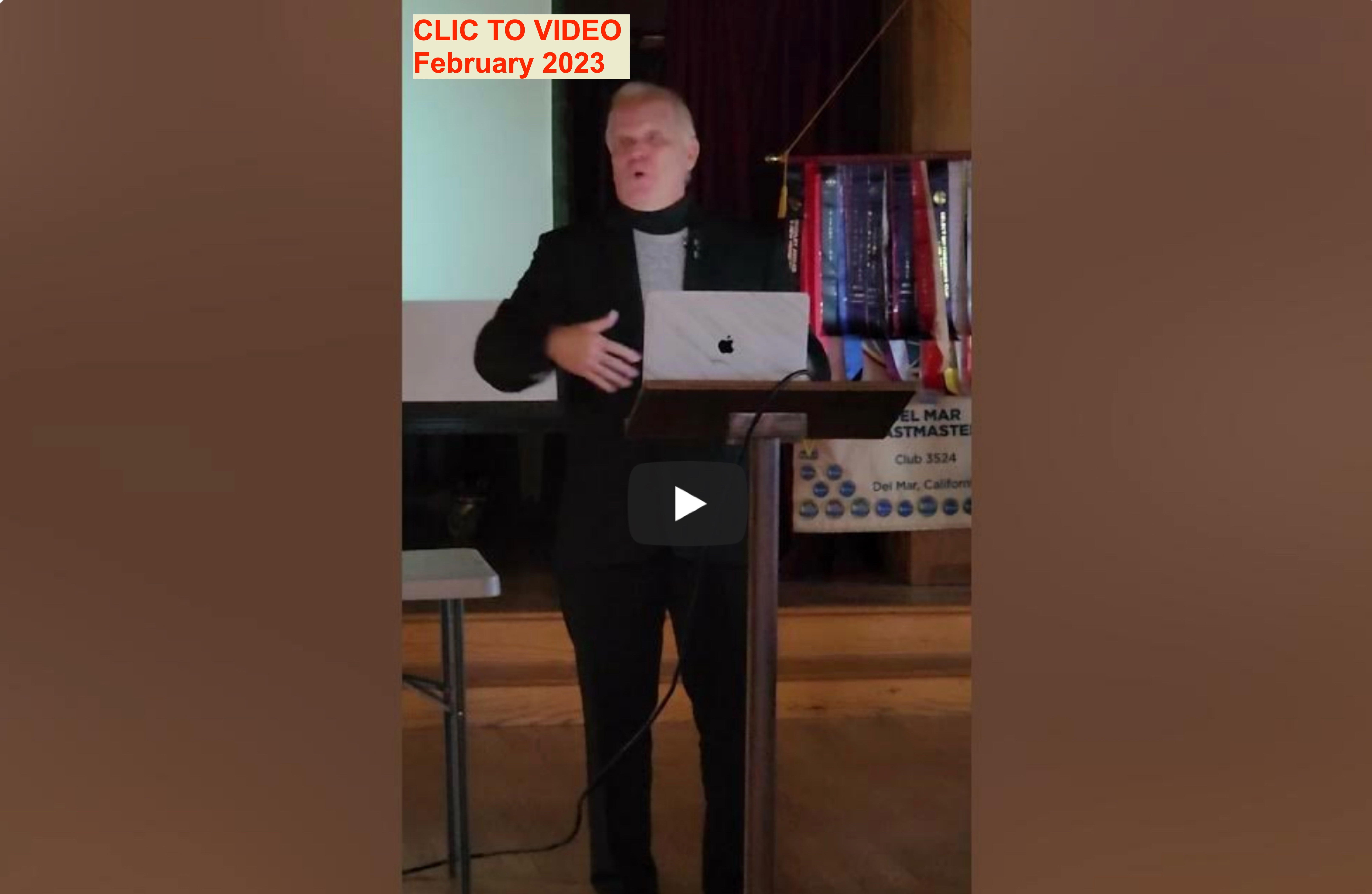
TOASTMASTERS SPEECH
ICEBREAKER INTRODUCTION
Timothy D Bilash - Presented February 17, 2023
ICEBREAKER INTRODUCTION
Timothy D Bilash - Presented February 17, 2023
I Am My Father's Son
TRANSCRIPT OF SPEECH
Timothy D Bilash
February 17, 2023
Hello everyone. This is my
first time speaking in front of this group, so thank you for the opportunity.
My name is Timothy Bilash. I’ve
lived in this area of San Diego for about fifteen years now, and this is the
first group that’s asked me to speak. Last week, some of you may remember, I
mentioned that I grew up not talking very much — and now I try to make up for
it whenever I get the chance.
You don’t really need to
know a lot about me, although I could tell you many things. The word that comes
to mind first is science. I’ve thought of myself as a scientist
since about seventh grade, and I owe whatever I’ve been able to do
professionally to mentors along the way — starting as early as elementary
school.
Another important word
is medicine. I’m a board-certified OB-GYN and have
been practicing for over 32 years. I deliver babies and take care of women’s
health.
I also like low-tech tools — pencil and paper. As a scientist and
physicist by training, I still love blackboards, chalk, and simple ways of
thinking things through.
I debated all week whether
to talk about what I think is important or to talk about who I am. Who I am
isn’t that important — it’s really just a path through
history — but I’ll share a little context.
I earned my MD from the
University of Illinois in a dual-degree program, along with a master’s degree
in physics. My undergraduate degree was from the State University of New York
at Albany.
I’ve done research, published, lectured, and worked across disciplines
including endocrinology, physiology, immunology, microbiology, nutrition, and
surgery.
I also advocate for a healthcare system that supports patients,
physicians, and nurses rather than marginalizing them.
But what I really want to
talk about is something I call the
kindness of strangers.
When you’re in medical
school, around your third or fourth year, you start applying for residency
programs. I was doing an OB-GYN externship in Irvine and had an interview
scheduled at the University of Colorado. I was driving through Utah early on a
Sunday morning — long stretches of road, forty miles between exits. I was
tired, lost concentration, drifted off the road, and punctured both tires on
the left side of my car.
I was stranded in the
middle of nowhere. No cell service. No money in my checking account or on my
credit card. The interview was the next morning.
A van drove past me. Then,
some time later, that same van came back.
A father and his two
children got out. They told me they’d seen me, driven thirty miles to the next
exit, turned around, and come back to help. They took me into town, where the
only open gas station happened to be an Amoco — which mattered because I had an
Amoco card. The station attendant went out, towed my car, replaced the tires,
and I didn’t pay a penny.
I made it to my interview.
I didn’t end up training
in Colorado — I went to Albany Medical Center in upstate New York — but I
honestly don’t know what would have happened without those people.
My life has been a series of kindnesses by strangers.
What you can know about me
comes from science, yes — but I am also my father, my grandparents, and the
people who came before me. My family comes from what is now Ukraine. They never
gave up. My father fought in World War II, came home with an 80% disability,
and lived his life with resilience and dignity. I honor him every day.
That’s really everything
you need to know about me.
Thank you.